What to know
- Age prediction, risk prediction and pace estimation are different tasks.
- Results from different clocks should not be averaged into a single truth.
- A changing biomarker is not automatically a validated treatment endpoint.
There is no single epigenetic stopwatch
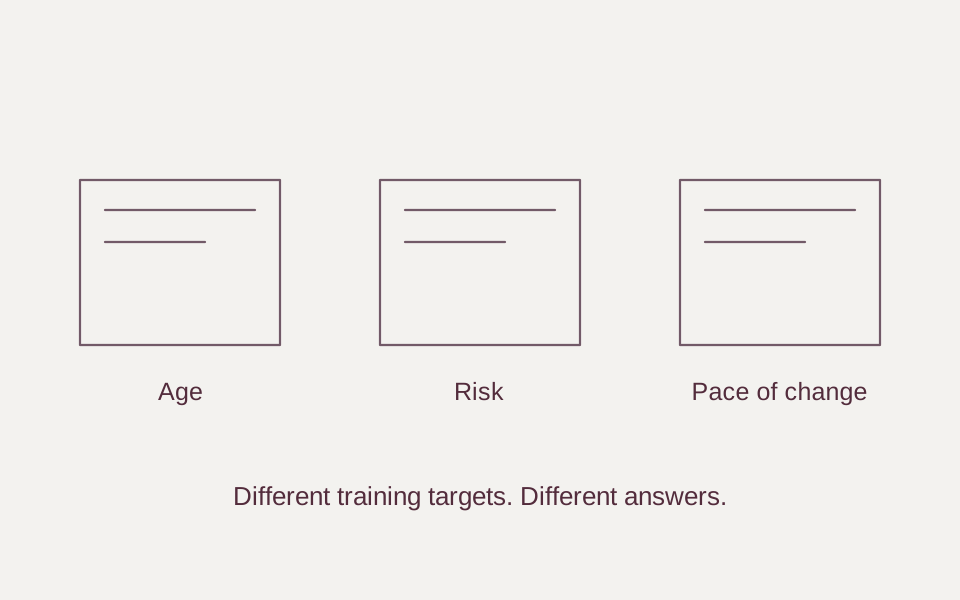
Two epigenetic clocks can disagree without either calculation being broken. They may have been trained to answer different questions. One estimates calendar age, another emphasizes risk-related patterns, and another models pace of change. The target matters more than the fact that all three appear under a biological-age heading.
Two clocks can disagree without either calculation being broken. They may emphasize different biological signals and have different reference populations. A careful interpretation begins with the exact model name, version, specimen and output units rather than with which result looks most flattering.
Calendar-age clocks established the approach
Horvath's 2013 work developed a methylation age estimator across multiple human tissues and cell types. Predicting age from molecular patterns was an important methodological advance. Yet a predictor trained to reproduce calendar age is not automatically optimized to identify a useful treatment target or quantify the benefit of a lifestyle change. [1]
Imagine two otherwise similar people with the same birth date. A model can estimate that date accurately while still being unable to determine which person will remain healthier. This is why a high correlation with chronological age should not be treated as the sole measure of clinical usefulness.
Risk-oriented clocks ask another question
GrimAge incorporates methylation-based surrogates, including signals related to plasma proteins and smoking history, into a mortality-oriented prediction approach. Lu and colleagues reported associations with survival and health outcomes in validation datasets. These results support risk-related research uses, but the output is not an individual countdown and a methylation surrogate is not identical to directly measuring the protein it estimates. [2]
That last distinction matters for commercial reports. A value inferred from methylation should be labeled accordingly. It should not be silently substituted for a conventional blood test used to investigate a specific clinical concern.
Pace estimates are not ages in years
DunedinPACE was developed from a longitudinal study of a 1972–1973 New Zealand birth cohort. Its training target summarized change across 19 physiological indicators collected from ages 26 to 45. The methylation algorithm translates a single blood sample into an estimate related to that longer trajectory, with further evaluation in other datasets. It is a model of pace, rather than a direct measurement of how many years old an organ is. [3]
A pace value and an age estimate cannot be compared by subtracting one from the other. Likewise, a reported change in pace does not directly specify added years of life.
Reliability matters across every generation
Higgins-Chen and colleagues demonstrated technical variation in several clocks and improved repeatability using principal-component methods. This is a reminder that predictive associations and measurement stability are separate properties. An algorithm may distinguish risk across a population while still making short-term individual changes difficult to interpret. [4]
Before interpreting a repeat test, ask whether the exact clock and laboratory process stayed constant. Also ask whether the company reports uncertainty or a meaningful-change threshold. A dashboard that rounds a point estimate into a highly specific age does not make the estimate equally precise.
Choose the interpretation before the intervention
For a study, the right clock depends on the research question and validation design. For a consumer, the useful question is what you would do with the result. A report may satisfy curiosity or provide an exploratory record. It should not be the sole reason to start a drug, select an invasive intervention or declare a treatment successful.
Clinical outcomes, functional capacity and conventional risk factors remain separate observations. Favor a service that explains disagreements between clocks and clearly distinguishes measured values from inferred ones. Our biological-age buying guide covers sample handling and repeat testing; the underlying scientific achievement is more interesting when its limits remain visible.
Keep each result in its own units and retain its explanation. A pace ratio, an age estimate and a disease-risk association belong in separate conversations, even when a dashboard displays them side by side.
Sources
Research describes groups and specific study conditions. Your medical history, symptoms and treatment decisions require advice from your own qualified clinician.